

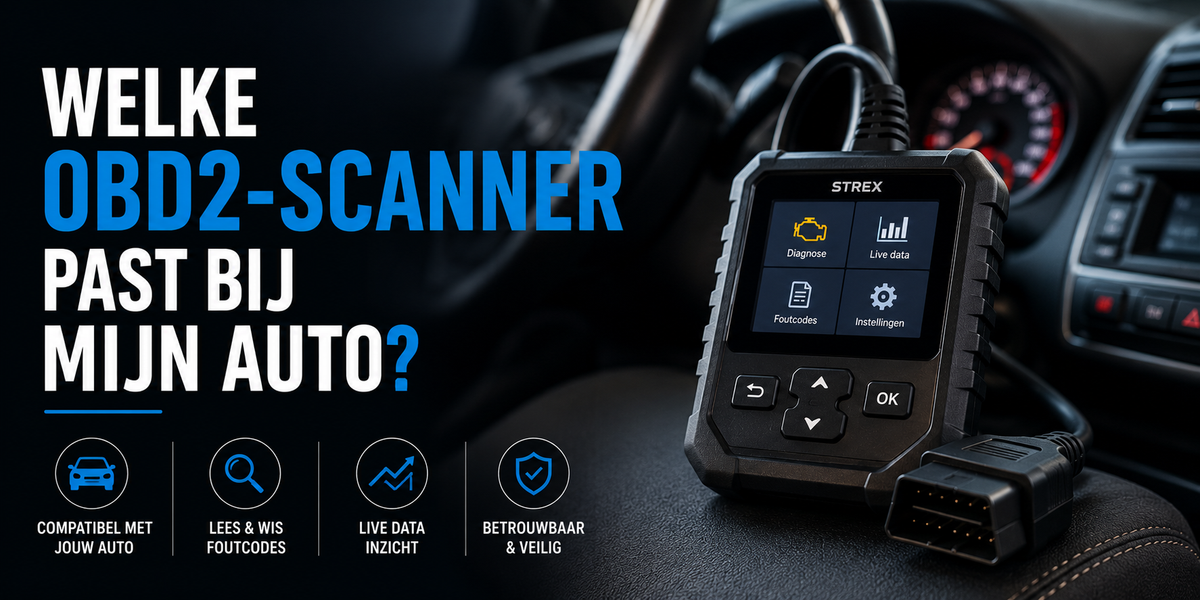
Good news first: the chance that an OBD2 scanner fits your car is very high. OBD2 has been a mandatory standard in Europe since the turn of the century—gasoline cars from about 2001 and diesels from about 2004 all have the same 16-pin port with the same basic codes. The real question is therefore not whether a scanner will fit, but which version suits you: a standalone device with a screen, or a Bluetooth dongle that works with your phone.
Step 1: does OBD2 fit my car?
The check takes half a minute. Look under the dashboard on the driver's side, usually to the left of the steering column or just above the pedals—sometimes behind a small flap or under a cover plate. If you see a trapezoidal connector with sixteen holes, your car is OBD2-compatible. If in doubt: everything running on gasoline in the Netherlands from roughly 2001 and on diesel from roughly 2004 falls under the mandate. For older cars, import models from outside the EU, or exotic cars, it's worth a look—but that is the exception, not the rule.
Step 2: standalone device or Bluetooth dongle?
This is the actual choice, and both have a clear profile.
Standalone scanner with its own screen
Plug in, ignition on, read—no phone, no app, no pairing. This makes it ideal to keep permanently in the glove compartment: if an orange light comes on while on the road, you grab it and know where you stand within a minute, even if your phone is dead or you are in a garage where you don't feel like dealing with apps. The honest side: the screen is more compact and you often read the codes without extensive explanations—you get the code, and you look up the meaning yourself.
Bluetooth dongle with app
Small device in the port, connection to your phone, and the app does the heavy lifting: codes with descriptions, live sensor data while driving (temperature, fuel trim, RPM), graphs, and a readable history. Ideal for those who want more than one code: tinkerers, people with a car that has a recurring problem, or those looking at a used car who want to know on the spot if the memory has just been cleared. Downside: you are dependent on your phone and an app that you have to get to know.
The choice in one line
- ✔ Do you mainly want to know what the light means? → standalone scanner, always in the car
- ✔ Do you want to monitor, measure, and track? → Bluetooth dongle with app
- ✔ Do you regularly buy used cars? → dongle: live data and cleared memories are worth their weight in gold during inspection
- ✔ Does the family share one car and nobody wants the hassle of apps? → standalone scanner wins on simplicity
Other things to look out for
Three points that make the difference between a scanner you use and one that ends up in a drawer. Clearing codes: the ability to turn off the light after a repair should be standard—without that function, a scanner is only half-effective. Live data: if you want more than just error codes, check if the model shows current sensor values; that is exactly what makes a dongle strong. And language and readability: a code like P0301 says nothing without a description—an app with Dutch or English explanations makes the difference between information and a string of numbers.
What a scanner does and doesn't do
Honest expectation management, because this prevents disappointment. It DOES: read which fault the engine management computer has stored, clear the code, and for most models, monitor sensors live. It DOES NOT: read brand-specific systems such as airbag, ABS, or transmission modules—that requires brand-specific or professional equipment. And most importantly: the code is the symptom, not automatically the diagnosis. A scanner tells you where to look and what to discuss with the garage—it does not replace the craftsmanship itself. That is exactly what our article "Engine light on? Here's what it means" is about, including the five most common causes.
One more instrument belongs in your kit
For the electrical side of diagnosis—battery, alternator, leakage current—an OBD2 scanner reads nothing; for that, a multimeter is the right tool. The two together cover almost everything you can determine yourself: the scanner for engine management, the multimeter for voltage (healthy resting voltage around 12.6V, over 14V with the engine running). Starting problems instead of an engine light? Then start with the battery—see "Car battery empty? Causes & solutions".
Frequently asked questions
Does an OBD2 scanner work on every car?
On almost every passenger car in Europe: gasoline cars from about 2001 and diesel cars from about 2004 are required to have an OBD2 port with standardized codes. Older models and some imports from outside the EU fall outside this—check if the 16-pin port is present under the dashboard.
Where is the OBD2 port in my car?
In most cars, it's under the dashboard on the driver's side: to the left of the steering column or above the pedals, sometimes behind a flap or cover plate. It is a trapezoidal connector with sixteen pins—recognizable the moment you have seen it once.
Can I turn off the engine light with an OBD2 scanner?
Yes, clearing codes turns off the light. Do this only after solving the cause: an unresolved fault will return within a few drives, and a freshly cleared memory is actually suspicious during an inspection or a pre-purchase check.
What is the difference between a scanner and a Bluetooth dongle?
Functionally, both read the same codes. The standalone scanner has its own screen and works without a phone—fast and simple. The dongle sends the data to an app on your phone, with descriptions, live sensor values, and graphs—more insight, slightly more hassle. Those who mainly want to know choose the scanner; those who want to analyze choose the dongle.
Want to know what your car has to say? Check out the OBD2 scanners, dongles, and multimeters from Strex—and go to the garage informed from now on.

